
From Earnings to Optics: Marvell’s AI-Driven Infrastructure Playbook
SHARE


Daniel Newman sits down with Chris Koopmans, President and COO of Marvell, to discuss how AI is reshaping data center infrastructure, why connectivity is becoming a critical constraint, and how optical technologies are enabling the next phase of scale.
The conversation around AI infrastructure has been dominated by compute, but that’s only part of the story.
Daniel Newman is back with Chris Koopmans, President and COO of Marvell Technology, at the company’s Silicon Valley headquarters to unpack what is actually driving the next phase of scale in AI, and why connectivity is quickly becoming the limiting factor.
Marvell is coming off a record year, with growth driven by accelerating hyperscaler investment and a surge in demand tied directly to AI infrastructure buildouts. But it’s becoming clear that compute alone does not define performance. As Koopmans explains, the growth in compute is creating an even faster expansion in the need to move data between systems, clusters, and even across data centers.
That shift is pushing networking, and more specifically optics, into a central role. As bandwidth requirements continue to climb, traditional electrical connections are hitting physical limits, making optical technologies essential for scaling modern data centers. Together, they explore how this transition is unfolding as a mix of approaches, architectures, and technologies working together across different parts of the infrastructure stack.
Key Takeaways Include:
🔹 Growth in AI compute is driving an even faster increase in connectivity requirements across infrastructure.
🔹 Hyperscaler CAPEX trends continue to accelerate, reinforcing long-term demand for AI infrastructure buildouts.
🔹 Optical technologies are becoming essential as electrical interconnects reach physical bandwidth limitations.
🔹 Data center architectures are diverging, with multiple approaches emerging to support different AI workloads.
🔹 Marvell is focusing its strategy on high-speed connectivity and targeted portfolio expansion to capture this shift.
Watch the full episode at sixfivemedia.com and subscribe to our YouTube channel for more analyst insights from the front lines of enterprise technology.
Disclaimer: Six Five On The Road is for information and entertainment purposes only. Over the course of this webcast, we may talk about companies that are publicly traded, and we may even reference that fact and their equity share price, but please do not take anything that we say as a recommendation about what you should do with your investment dollars. We are not investment advisors, and we ask that you do not treat us as such.
Chris Koopma:
It seems like every time there's a new trend, people want to think, oh, what's that bad for? But in general, it seems like every single time there's a new trend, it's good. It means more connectivity. That's the sort of high level theme that I keep seeing is that no matter which one of these trends that you're talking about, it's I need more stuff to get connected together.
Daniel Newman:
The Six Five is on the road here in beautiful Northern California in the Silicon Valley. Excited to be back here at Marvell's global headquarters to have a conversation with Chris Koopmans, a regular here on The Six Five. It's good to be back, Chris. Good to be here. Good to be with you. Great to be here. Yeah, it's good to sit down. I remember it's been crazy. It's been four months since we last sat down because it feels like we do this, you know, pretty regularly. Love having you on. And we were talking all about sort of connectivity being the next constraint. It looks like the signals are all there while the macro has been a little crazy, you know, been going event to event to event. And as we've seen, you know, everything was about compute for a while. But networking's in vogue. It's got to be a great way to start the year for all the things you've got going, because you are compute and you are connectivity.
Chris Koopma:
That's right. Yeah, I mean, all the trends are intact. In fact, I would say since the last time we've met, one of the big changes has been CAPEX signals from the hyperscalers and the data centers in general for this year are actually dramatically larger than anybody was planning. Ultimately, both of those, you mentioned compute and connectivity, but what I think is finally starting to be recognized is that compute drives exponential growth in connectivity because the amount of connectivity you need between the two grows even faster than the compute itself. Certainly, it's been a great growth driver for Marvell. I think Marvell grew faster than pretty much any chip company last year other than NVIDIA from a large semiconductor company perspective. And it really was driven by both, but certainly in large part by connectivity.
Daniel Newman:
Yeah, let's talk about that. Record quarter, excellent guidance. Like I said, you can only do so much. The market reacted really positively, but then you can't help when you've got wars and different things going on around the world. And by the way, something you said is really prescient. I mean, you talked about those CapEx numbers growing. As an analyst, I can say, I can confess this, we've been wrong every step of the way too low. And I actually was one of the few that said we could do a trillion in semiconductors, trillion plus in infrastructure and AI this year. And I think you said it, it's actually come true.
Chris Koopma:
I think it's going to come true. I think that everybody had the CapEx numbers wrong. I don't think anybody expected the acceleration to continue this year. Certainly seems that way. And ultimately, that the investment that's being made is actually delivering results. And I think that's what you're seeing is that the more hardware means better outcomes and more revenue for the data center companies. And that's what's driving them to increase their span.
Daniel Newman:
And by the way, it's also AI is becoming like really high utility, right? I think last year, I don't know how many times you had to answer the question, Chris, like, is AI a bubble?
Chris Koopma:
Right.
Daniel Newman:
I answered it, I think I did 100 television appearances last year answering that same question. And then I think that the conversation not only did the CapEx numbers grow, the connectivity momentum popped into place, but I think the new narrative is AI is a bubble because it's so good. that it's going to disintermediate every industry and now every one of these companies is accelerating their spend. But all this to say Marvell crushing it, record numbers, incredibly good guidance, connectivity is the trend. What are some of the things you're seeing more broadly that's powering this and giving you guys the confidence to give the street that kind of guide?
Chris Koopma: Yeah, I think, well, we talked about it. I think there's a few things. Number one, CAPEX numbers are coming up. Number two, of course, our products are on order. The backlog has been growing dramatically. But number three, we're just seeing these bigger trends. This is such a fast-moving space. It's such an exciting time to be in a semiconductor and the computer architecture space more generally, because it's not a one-size-fits-all. You have the emergence of inference, and you have reasoning models, and all these new KV caches are growing, agents. And it seems like every time there's a new trend, people want to think, oh, what's that bad for? But in general, it seems like every single time there's a new trend, it's good. It means more connectivity. That's the sort of high-level theme that I keep seeing, is that no matter which one of these trends that you're talking about, I need more stuff to get connected together. Let's just take KV caches, for example. that's grown a need for a lot more memory, but memory is limited. And so that's seen an explosion in our CXL portfolio, which is a memory interface controller. We're seeing, you see a growth in the cluster sizes. Well, now they have to add another layer of switching that grows more in our scale out. You're seeing in some cases, these models are going across data centers and you have the emergence of scale across, which is extending the backend network across data centers and adding more scale across modules from companies like Marvell. So each of these trends, it's never clear exactly what's going to be the next trend, except that we're seeing more and more need for high-speed connectivity in these days.
Daniel Newman:
Well, I think there is a trend that you can identify, and that's optics, right? That seems to be really powering where we're heading in the future. It's an area you're very focused on. You guys kind of look at connectivity very portfolio-wide, but talk a little bit about what you're seeing with optics, because that seems to be the next constraint to something. You said this, that you're about connectivity as a constraint, but optics specifically, we got to move data faster.
Chris Koopma:
Yeah, I think ultimately this is the conundrum, is that the easiest way to move data is with an electrical signal over a copper wire. That's a physics problem, though. Every time you double the bandwidth, you half the distance you can push it. And so the only way to get past that physical barrier is with a fiber optic cable. And that's why you saw the optical industry basically born in telecommunications, because the first things that went optical was the undersea cables. and then the cross-country cables, and then the between data center cables, and then the inside data center but across all of the racks cables, and eventually it's the within the rack. And what you're seeing is every time the bandwidth is increasing, and we've been on this trend for like decades now, bandwidth is constantly doubling, bandwidth requirements are constantly doubling. And so ultimately all those connections need to go optical. It's really the only solution. And the beautiful thing about the optic space is that it is not a zero-sum game. There's not like one solution that's going to win in this space. You see all these, this explosion of new technologies. You can't use the same technology which would be like a coherent DSP to connect an undersea cable to connect inside of a data center just like you can't use the same exact technology inside of a data center inside of a rack. You need to be more optimal. The bandwidth and the requirements and the density gets higher and higher and so what we're seeing it's super exciting and Marvell made a number of announcements in this space recently with like we announced I think four new 1.6 DSPs for scale out. We announced our new two nanometer 1.6D DSP for ScalaCross. We announced an investment in a partnership around micro LED technology. Ultimately, I see optical connectivity and the different types of silicon photonics and optical connectivity inside of a data center being as important as CERTES is to electrical today. And so we're building a massive, broad platform. and have every single technology under the sun to help our data center customers scale their infrastructure.
Daniel Newman:
I think it's important to double down on this topic just a little bit, Chris, because we hear a lot about CPO, co-packaged optics, right? People are talking about it. Some people kind of make it the be all end all, and a couple of things have been happening. One is it's taking longer, right? It's not happening, you know, it's like five years away from being five years away thing. It's not, it seems like it's, there's a timeline, right? By the end of the decade. But you guys obviously address, you know, it's modular, it's on chip, there's different ways to approach this. It's not just CPO, right? It's going to be all of the above, which you kind of called out, but I think it's like important that people hear that, because I hear a lot of people saying, oh, it's CPO. No, that's just one of the modalities to do optics.
Chris Koopma:
Yeah, I mean, we talk about CPO in sort of a binary fashion, and the reality is there's a multitude of capabilities there. And really, there's different parts of the data center. How do we do co-packaged optics in scale out on the Ethernet fabric? How do we do it in scale up in the emerging scale up fabric? There's so many different ways of doing co-packaged and near-packaged optics. And the way I think about it, and the way we think about it here at Marvell is, We're coming off of OFC, by the way, and I always think at OFC, you have these physics, almost religious debates of this is the only way to do it, or that's the only way to do it. And for me to be right, everybody else has to be wrong. I just don't see the world that way. I think at Marvell, we think all these technologies have a place. All these emerging technologies have a solution. Speaking of CPO, there's a big battle going on about which modulation technology is the best modulation technology. And I get asked that question all the time. At the end of the day, I don't think there is one best technology. We have EAM, MRM, MZM. We're using all of them. Marvell has teams working on all of them today. MZM we use today in our scale across. We're working on MRM with TSMC's COOP and our Celestial AI acquisition brought in EAM technology. And we think that all these technologies will have applications in the data center. And it's important for us to hit all of them and to serve our customers.
Daniel Newman: I mean, it's to be very, you know, because you're getting a little technical there and just for everyone that's not, no, but like all different modulations, right?
Chris Koopma:
And I think when you… All different modulations and technologies. And they take different laser types in some cases, which helps with supply chain capabilities. And as I said, we're even investing in new things like micro LED. I think you'll see an emergence of… And why is that? Because all of these are hard technical challenges that existing solutions won't solve. And so the industry, Marvella and the industry at large, is inventing new technologies to solve new problems. And I actually think there's opportunities within this giant TAM for many of these to be successful. And it's not sort of a everybody else has to lose for one to win.
Daniel Newman:
Yeah, I like that. I always say there's like the words and and or need to be used differently because most of the time it's and. you know, going back to conversation we had a few times and just pivoting to kind of data centers and how they're being built, but there was this period of time where it was, oh, it's GPUs. Right. And then custom came, right? And the idea was, you know, there were certain people on stage talking regularly, it's going to only be, and custom won't be a thing. And now I think it's widely accepted that custom is going to be a thing and GPUs are going to be a thing. And by the way, now with agents, CPUs have, had a renaissance, because I think there was a report for a period of time that CPUs were dead. I mean, joking, but like that kind of happened. But like data centers are being reimagined. I mean, and so as you're very involved, right? You're playing in the connectivity space, but you're also playing in the custom silicon space. And essentially your portfolio is capable of building most of what the infrastructure is needed to stand up these next generation data centers. What are you seeing, kind of how is that changing? Right now, hard data centers are being designed differently.
Chris Koopma: So first of all, I think that is an excellent observation. Thank you. This and. Everybody wants to know, hey, is it CPO or pluggables? It's CPO and pluggables. Hey, is it EAM or MRM? It's and. Is it GPU or CPU? It's and. Is it custom or merchant? It's and. Across all of these things, right? And ultimately what you're seeing is the reason for that is that the applications, this is all driven by software. The software that's being built is changing at a dramatic rate right now. And so you can't just design an architecture that will be optimized for all of those things. There's a lot of different applications, a lot of different workloads, and the size of the TAM. You can think back, there was a world where it was one size fits all, where you just built x86 servers and you ran all your workloads. That's because the workloads were doable there. You could make everything work on an x86 server. these workloads that we've now come to imagine and are actually implementing, they don't work that way. They don't work on any one system and nothing is optimized today. And we're working so hard to optimize and build all this infrastructure to optimize for that. So I think ultimately, it's probably the most exciting time in computer architecture since the late 80s or early 90s, where you're seeing this explosion of opportunities and you're seeing different ideas that are all being successful back to the end. And We'll see how that all evolves in the coming months. But certainly, I think from a customer perspective, we see that directly. We see the projects because these projects take time to come to fruition. And so we're seeing an explosion of projects. We're at a time of sort of like the architectures are diverging, not converging. They may converge again one day, but right now they're diverging. And you're seeing a multitude of new architectures coming out and pushing the data centers into new directions. And I think it's awesome. I mean, you're just seeing this innovation at its finest right now.
Daniel Newman:
So you sort of touched on it, Chris, but as this evolves and as all the ands are here, Marvell has to be evolving itself, right? So how are you sort of playing into this change right now? How are you changing your strategy? How are you evolving your portfolio? to be able to address because, of course, you want to be able to tackle all of the ends, but at the same time, you have to pick where you're going to be optimal, where you're best, where you can, by the way, just with constraints, where can you even dedicate your capacity? So how are you sort of picking and choosing where to, you know, put your energy in portfolio development?
Chris Koopma:
Yeah, it's a great point and right now it's a lot about scaling. If you think about where we are, Marvell grew our company total revenue from something like 5.8 billion to 8.2 billion last year. We're kind of right around, I think consensus has said like 11 billion this year and something around 15 billion the following year. That's a massive scale clip, right? To be able to grow that fast. How do we make sure that we're investing in the right products? How do we make sure we have the right customer relationships? How do we make sure that we have the right supply chain capacity? You know, all of those things. And you're right. At the end of the day, it's partially about decisions, right? And being focused. My belief system in general is that if you try to do everything, you'll probably fail. So what you try to do is pick a certain number of things that you think you can really focus on and really concentrate on and do well, and that'll help you succeed, obviously, as long as you pick the right things. And so we definitely have pivoted the company to put extreme focus on this TAM expansion, which is happening in the data center market right now. And ultimately, the way I think about our company is what we have at our core is high-speed connectivity IP of all kinds. Thousands of people that are rare and amazing engineers that are doing the hardest stuff in the world is building this high-speed connectivity IP. So how do we make sure that we put them to work on all of the right sets of opportunities going forward? And that's a big focus for us. And you can't just vibe code it? Well, we haven't figured that out. I will say, though, the adoption I've seen of AI tools in our engineering community blows me away. The stuff they're accomplishing and the stuff that they're doing, people often say, hey, did you save people? Do you have fewer engineers? Take a step back. Remember the days when you taped out a chip with tape? That's why they call it taping out. You did it manually on a board. So ask yourself a question. Could anybody build a two nanometer chip today with that? Of course not. we have this huge EDA tool set. That's the way I think about AI tools for chip design. It's not, I'm going to save people. It's going to make us build better chips faster than ever before. And by the time we fast forward five or six years, you're going to say, it's actually impossible to do the work we're doing without all of these amazing tools.
Daniel Newman:
Yeah, and that's fun. And by the way, I was kind of being a little bit funny when I asked you the question, but I love the way you answered that because these are really practical, real-world examples of how AI is creating scale. And engineers, like you said, because there's only two choices. I always say it's either the one-tenth or the 10x, meaning you're either trying to do the same amount with less. But realistically, when you're scaling the way your business is scaling, you're going to try to take the same resources or even a few more resources and 10x it, right? And that's the path you're on.
Chris Koopma:
A hundred percent. And another way to think about it is that the semiconductor industry, somewhere around 2005 or so, you know, it stopped growing as fast. And you started seeing more engineers out of college going into software. Now semis are exciting again, but the reality is we don't have enough people. We can't hire fast enough. Our competitors can't hire fast enough. There's not enough actual talent. So one of the things that we do and what we look at with our AI tools is can we bring in fresh engineers and have them be as effective as maybe an engineer with 10 years of experience within a year? And ultimately, I can see the demographics of our workforce. We're increasingly a younger and younger company as we grow our intern program and hire new college graduates straight out of university and then pair them up with all of these industry experts have been doing this for a few decades and hand them a modern AI driven tool set can make them effective right out the shoot. And so ultimately, these tools become part and parcel to growing a company that fast.
Daniel Newman:
That's awesome. And what a refreshing perspective because, you know, you turn on the news, you listen to a lot of people talk about the doom and this thing and this, it's like, this is a real practical example of where young talent can come up and basically learn new things at incredibly fast pace, right? An engineer that maybe doesn't, didn't come out with the exact skill set and tool set with AI, with all the tools you've given them can suddenly become Silicon engineers in a short order and help build the future.
Chris Koopma:
A hundred percent. I think of it, people sometimes ask me, hey, and I have kids in college. People ask the question, like, oh, what should we go into now? And how should we? And generally what I say is like, like for me, I went to school and I went to college when the internet was just kind of coming to be a thing. And so if I sort of look at what was successful back then, we used to say the internet. Which companies are on the internet? Of course, today, every single company obviously is on the internet. And so I think about it the same way. The businesses and the people and the students that I worked with at the time that were probably most successful were those that embraced that new technology and applied it to everything they did. The same thing applies here, whether you're going into law or whether you're going into software or whether you're going into accounting, I think the more you embrace the newest technology, put it to work and you'll do great in any of those professions.
Daniel Newman:
That's fun. And by the way, a really fun way to end. I don't know about you, but my agents are working as we speak. I have them going all the time now. I never thought I'd be an engineer or a coder, but I'm a full-stack engineer now because of Cloud Code. So I just want to thank Andrew for that. But in all seriousness, Chris, it's a lot of fun to sit down. Congratulations on all the progress that's being made. That growth in revenue, that projections, the guidance, the TAM, and the success, it doesn't come without a lot of sweat. Thanks for coming by, Dan. Always great to see you. Always great to chat. Good to be with you. And thank you so much for being with us here. We are the Six Five on the road here in the Silicon Valley at Marvell's headquarter. Great conversation there with Chris Koopmans of Marvell, talking about the future of AI, optics, connectivity, and a little segue down the road of the future of jobs, employment, and Silicon engineering. Stick with us. Be part of our community. Hit subscribe for this episode. We got to go, though. We'll see you all later.
MORE VIDEOS
The Six Five Pod | EP 299: OpenAI’s $122B Raise, Google’s TurboQuant Shock, and NVIDIA’s Infrastructure Endgame
OpenAI locks in the largest private funding round in history, Google disrupts memory economics with a major efficiency breakthrough, and NVIDIA continues to consolidate control over AI infrastructure. This week, Patrick Moorhead and Daniel Newman unpack the clear shift from model competition to full-stack execution.


Rethinking Data Security, Governance, and Resilience for the Agentic Era
Anand Eswaran and Rehan Jalil join Patrick Moorhead and Daniel Newman to discuss how enterprises must rethink data governance, security, and resilience as AI shifts toward real-world deployment. The conversation explores why unstructured data is central to AI and how organizations can build trust at scale.
.png)
How Autonomous IT Is Redefining Enterprise Operations
Matt Quinn, CTO of Tanium, joins Patrick Moorhead and Daniel Newman at RSAC 2026 to discuss how Autonomous IT is transforming enterprise operations, shifting from reactive systems to real-time, AI-driven decision-making at the endpoint.
Other Categories
CYBERSECURITY
Threat Intelligence: Insights on Cybersecurity from Secureworks
Alex Rose from Secureworks joins Shira Rubinoff on the Cybersphere to share his insights on the critical role of threat intelligence in modern cybersecurity efforts, underscoring the importance of proactive, intelligence-driven defense mechanisms.

HP Launches World’s First Business PCs to Protect Against Quantum Hacks - The Six Five On the Road
On this episode of the Six Five - On the Road, hosts Patrick Moorhead and Daniel Newman are joined by HP's Ian Pratt, Global Head of Security for Personal Systems.
What is Autonomous Endpoint Management?
Autonomous Endpoint Management is a framework designed to unify IT operations and security teams on a single platform through real-time control and visibility.
QUANTUM
Quantum in Action: Insights and Applications with Matt Kinsella
Quantum is no longer a technology of the future; the quantum opportunity is here now. During this keynote conversation, Infleqtion CEO, Matt Kinsella will explore the latest quantum developments and how organizations can best leverage quantum to their advantage.
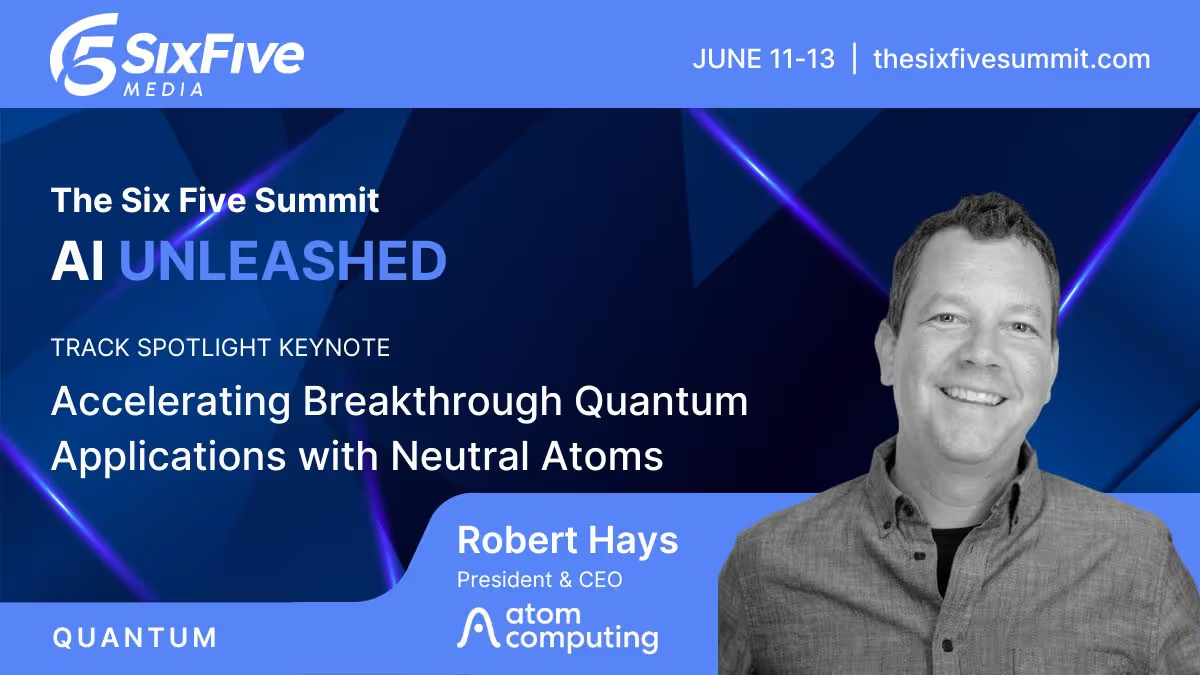
Accelerating Breakthrough Quantum Applications with Neutral Atoms
Our planet needs major breakthroughs for a more sustainable future and quantum computing promises to provide a path to new solutions in a variety of industry segments. This talk will explore what it takes for quantum computers to be able to solve these significant computational challenges, and will show that the timeline to addressing valuable applications may be sooner than previously thought.